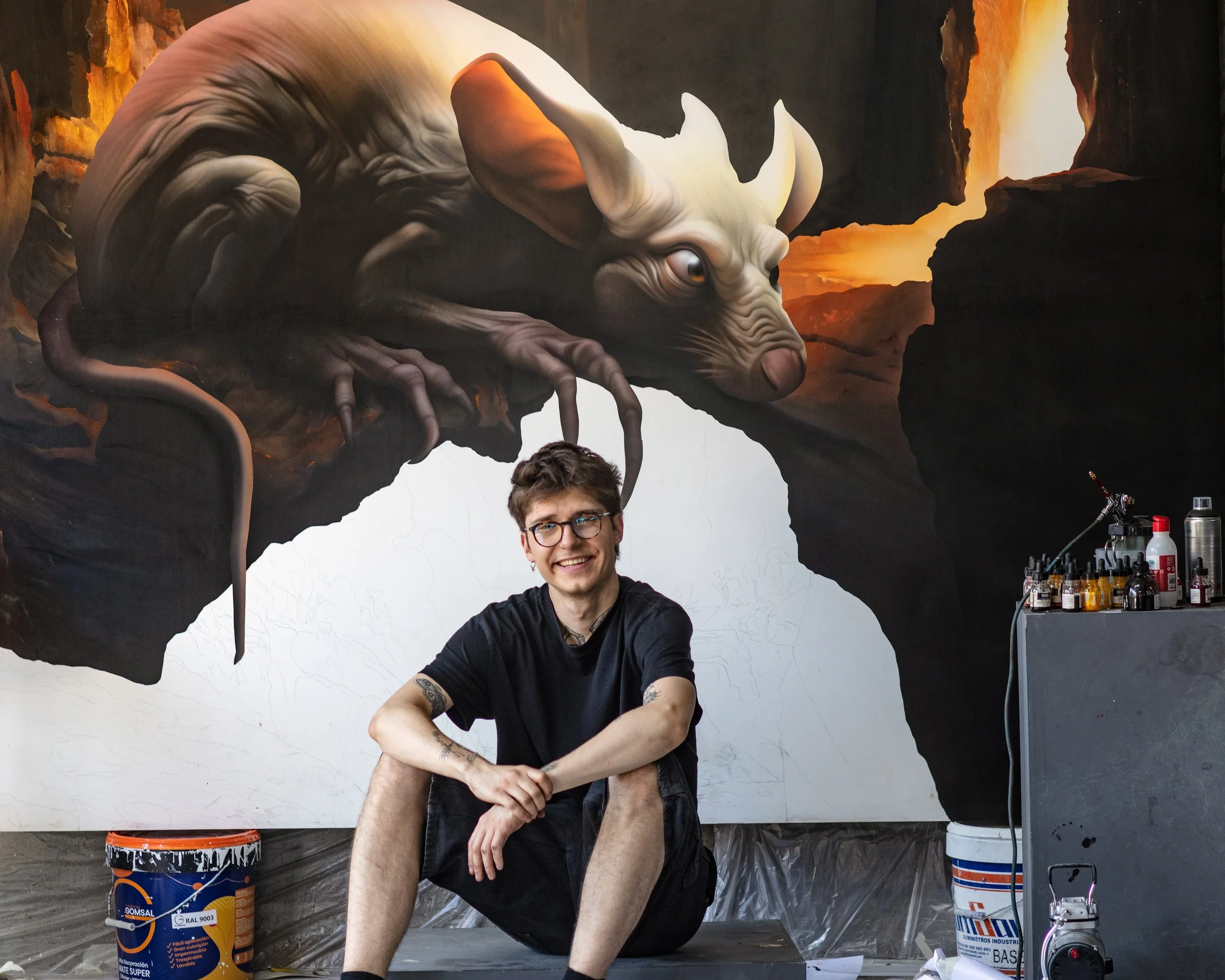
Maciej Kość’s practice is concerned with the relationships that emerge between existing images, objects and cultural forms. Working primarily with acrylic, airbrush and soft pastels on linen and wood, he brings together animals, furniture, design, stories and fragments of visual culture to construct paintings that occupy an uncertain space between reality and fiction.
Kość is interested in the overwhelming abundance of imagery that already exists. Rather than viewing painting as a means of producing something entirely new, he questions the value of adding another isolated image to an already saturated world. His practice instead begins with looking and searching: for objects, images and forms that already carry histories and meanings, and for previously undiscovered relationships between them. In this sense, he approaches painting partly as a curatorial process, selecting and arranging existing things until they begin to suggest something beyond their original identities.
Displacement and recontextualisation are central to this process. An animal can acquire the qualities of an object; an object can begin to resemble a living thing; a historical design can enter an entirely different narrative. Kość is interested in the unstable space created by these transformations, where things retain traces of their original identities while becoming something else. His compositions often bring together elements that belong to distinct systems of knowledge—natural history, design, illustration, popular imagery and cultural history—allowing them to interfere with and reshape one another.
This approach produces paintings that deliberately hover between reality and unreality. Their subjects are often recognisable and grounded in existing histories, yet their combinations are impossible. The resulting images can resemble museum displays, diagrams, specimens or illustrations, while simultaneously resisting a fixed interpretation. The viewer is encouraged to move between different systems of meaning, oscillating between what appears factual and what is clearly constructed.
For Kość, painting is therefore less an act of beginning with a blank canvas than a process of selection, displacement and recombination. Existing things are given new contexts and relationships, producing not necessarily a new image, but a new way of seeing what is already there.